Lido di Spina
Lido di Spina is in Emilia Romagna, in the municipality of Comacchio, province of Ferrara.
The resort is the Queen of the Emilia Romagna Riviera for the quality of its environment and good life style.
It marks the border between the 27 kilometre-long beach of the seven coastal resorts on the delta and the province of Ravenna.
Lido di Spina is one of the seven Lidi di Comacchio which are:
• Lido di Volano
• Lido delle Nazioni
• Lido di Pomposa
• Lido degli Scacchi
• Porto Garibaldi
• Lido degli Estensi
• Lido di Spina
The presence of vast areas of great naturalistic interest, the availability of sandy beaches not found elsewhere, the proximity of art towns such as: Ferrara, Bologna, Ravenna, Venice, make Lido di Spina the ideal destination for anyone who wants to spend holidays and periods of relaxation surrounded by beaches, nature, art, culture and entertainment.
Routes: Comacchio | Ferrara | Pomposa | Mesola | Ravenna

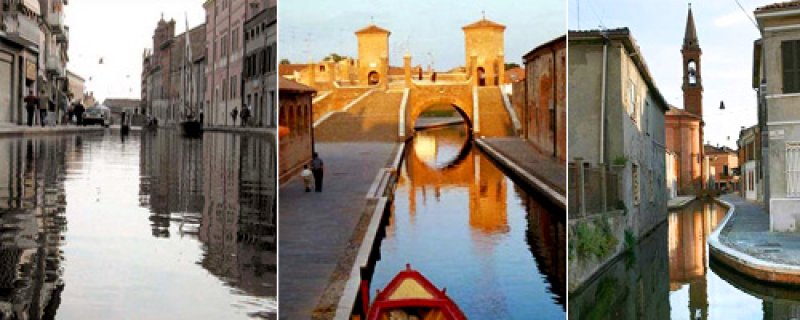
Another sight that simply must not be missed is the Museo del Carico della Nave Romana (Roman Galley Cargo Museum) that holds the relics found aboard a merchant ship that sailed these waters in the 1st century BC..
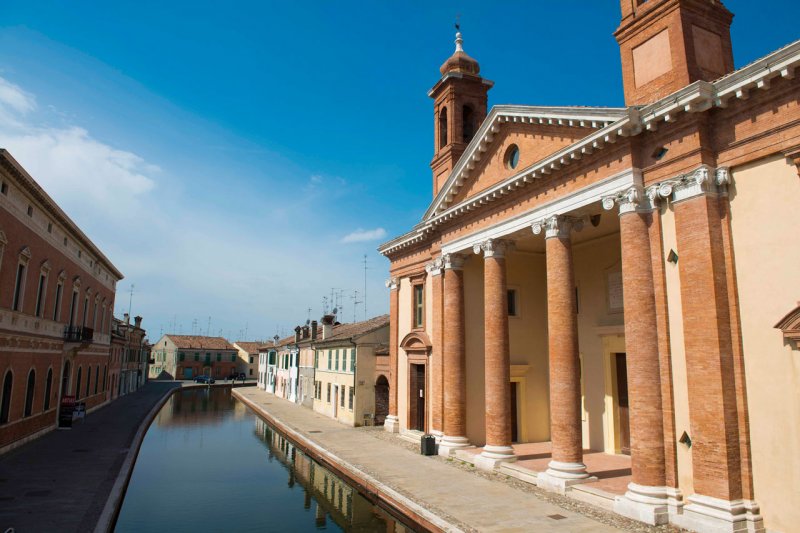
"Trepponti" is the city monumental
bridge and gateway constructed at the order of Cardinal
Pallotta in the first half of the 17th Century and designed
by Architect Luca Danese.
Trepponti bridge is composed of five-arched staircases
that descend from a central staircase that leads into
the square where the fish market is held every morning
inside the picturesque building also built in the 1600s.
Typical lagoon boats known as "batane"
that take on passengers for even more suggestive
views of the city are moored along the canals.
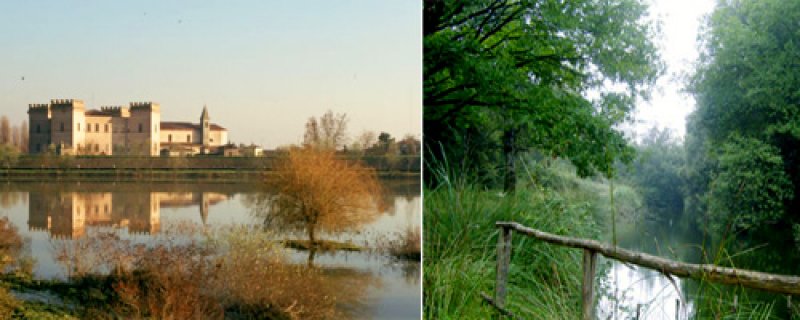
A few kilometers away from the city stands the Valli
di Comacchio, 11,000 ha of salt marshland brinked
by raised embankments that provide home to the lagoon
characteristic fauna and flora. Two particularly suggestive
points are the peninsula of Boscoforte and the le
Saline salt-flats where a healthy population of
flamingos can be admired in the right season.
The Po Delta Regional Park
is the district largest regional park and occupies a
considerable part of the Emilia Romagna territory. The
Park is divided into six different zones, each with
its own attractions of wildlife, landscape, history
and culture.
Visitors can explore the Park extraordinary beauty along
various itineraries laid out for automobile, bicycle,
and foot.
This ancient alleys and sumptuous palazzi of this magic
city are steeped in the history and splendour of the
Nobles Estensi and the Renaissance. Ferrara has been
declared World Heritage by UNESCO for the protection
of its unique monuments and architecture.
Ferrara began its municipal and cultural development
towards the end of the 14th Century, when it was further
graced by the addition of today Duomo (the Cathedral),
constructed in Romanic-Gothic style between the 12th
and 14th Centuries holding numerous frescoes, paintings
and sculpture by Garofano, Guercino, and Bastianino
(16th Century) together with numerous other monastic
centers. Ferrara can be neatly divided into two distinct architectural
styles: the Medieval area that runs from the Castle
along Via della Giovecca, Via delle Volte and Porta
d’Amore, and the Renaissance area that includes
Street Ercole I d’Este (know as "degli Angeli"
long ago) that leads to the ring that closed the daunting,
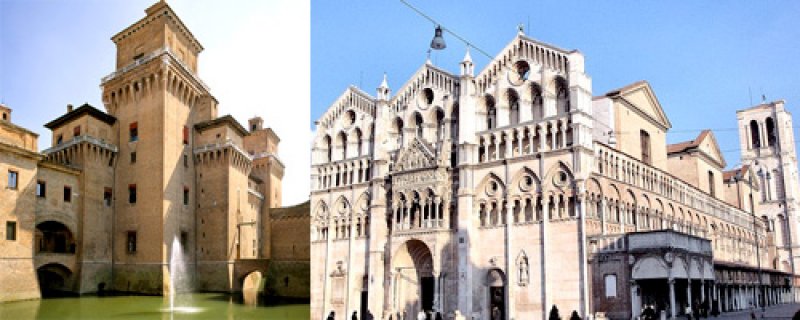
splendid walls in ancient times. The city symbols are the Castello Estense
(Este Castle), begun in 1385 as a fort and completed
in the 16th Century astride the two areas above, an
architectural treasure with its Medieval Tower of Lions,
subterranean dungeons, gothic chambers on the ground
floor, and spacious halls with frescoes by Bastianino,
Girolamo da Carpi and the Filippi father and sons (16th
Cent. Game Room); Palazzo dei Diamanti presents
an interrupted geometric facade of stone worked to diamond
shape. Ferrara can be explored by simply strolling
through its streets, the actual annals of Renaissance
time and culture, that amply suggest the city glorious
past even today. A truly special atmosphere reigns in the city center,
where the rhythm of life is cadenced by the passing
of hundreds of bicycles amidst the shores and coffee
shops.
History stands on every corner, in its sumptuous palaces
and winding Medieval alleys, and comes alive
once again in the colours and music of the annual pageant
of Palio di San Giorgio.

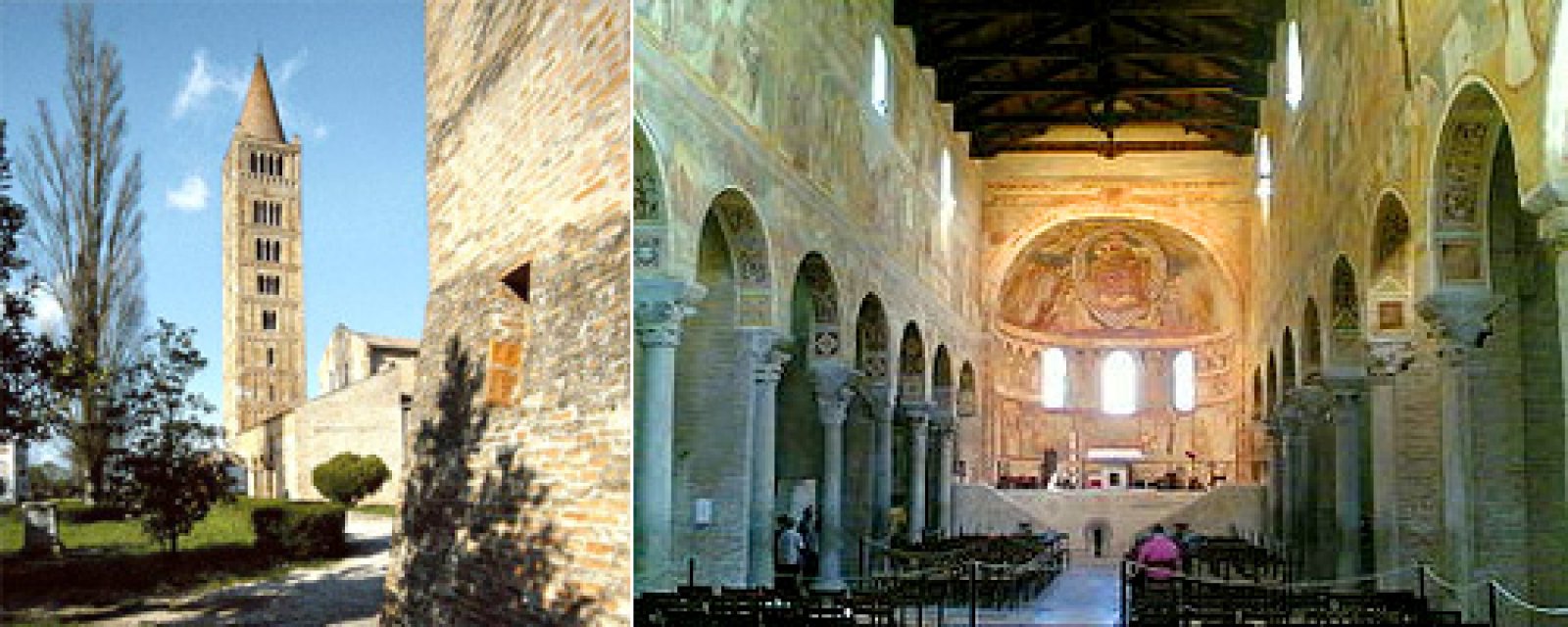
The Abbey has hosted many numerous guests over the
centuries, from Barbarossa to Dante Alighieri. Constructed
over the years in a mixture of Romanic and Byzantine
styles, its treasures include masterpieces of both the
Ferrarese and Bologna Schools of art.

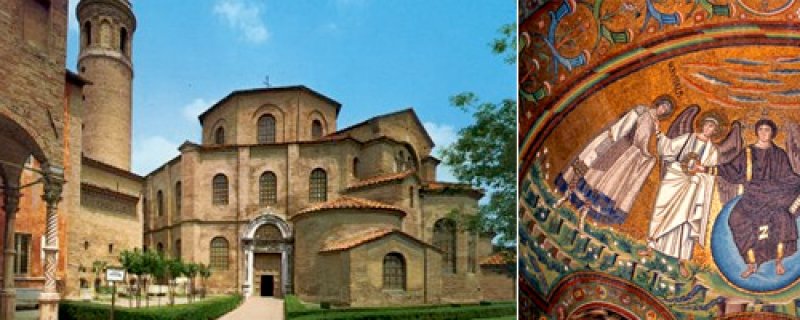
Many religious buildings hold excellent works of Oriental beauty and mystique (exquisite mosaic work in golf leaf and lapislazuli …), the most famous being the Basilica Ursiana with its five naves erected beneath the Vescovo Orso Bishopric, the Basilica of St. John the Evangelist (425), the Church of Santa Croce and the Mausoleum of Galla Placida.
One of the most striking expressions of renewed Imperial
Byzantine grace and grandeur is the Basilica di S.
Vitale, with its precious marbles, mosaic-work depicting
the Emperor Justinian and Empress Theodora, classically
elegant capitals etc. Ravenna reached her maximum splendour
in the period following the re-conquest of Italy by
Justinian, Emperor of the East. S. Apollinare in Classe, consecrated in 549,
offers the fortunate visitor a glittering, gem-studded
cross set above in the starry sky of the apse, and the
brilliant mosaic-work composing the Transfiguration
of Christ on Monte Tabor that gives the astonishing
effect of embroidered fabric and carpet.